The Call Stack
Stack questions test whether you can reconstruct the path to a failure, understand why an error was—or was not—caught, and distinguish a blocked main thread from an asynchronous wait. These skills matter when debugging production bundles, React render failures, and callbacks whose visible stack no longer includes their scheduling origin.
Chapter 3 — The Call Stack
Learning objectives
After completing this chapter, you should be able to:
- trace synchronous calls in last-in, first-out order;
- distinguish the execution-context stack, engine frames, and stack traces;
- explain how returns and thrown errors unwind active calls;
- explain why
try/catchdoes not cross a later asynchronous boundary; - reason about recursion limits without inventing a universal maximum;
- distinguish JavaScript call stacks from React component stacks.
Quick Refresher
- The call stack is the practical model for unfinished synchronous calls.
- The most recent callee runs first and completes before its caller resumes.
- ECMAScript specifies an execution-context stack; engine frames are implementation details.
- A thrown value propagates outward through active calls until a matching
catchhandles it. - A later callback starts a new synchronous call chain; the scheduling call is no longer active.
- Async stack traces preserve causality, not live frames.
- Stack depth does not measure duration, and ECMAScript defines no universal recursion limit.
Why This Matters
Stack questions test whether you can reconstruct the path to a failure, understand why an error was—or was not—caught, and distinguish a blocked main thread from an asynchronous wait. These skills matter when debugging production bundles, React render failures, and callbacks whose visible stack no longer includes their scheduling origin.
The terminology can blur easily. ECMAScript specifies execution-context transitions. Engines implement frames and expose formatted stack traces. For ordinary synchronous calls the models align closely, but they are not identical guarantees.
Core Mental Model
For synchronous code, treat the stack as a last-in, first-out record of unfinished calls:
- A call places the callee above its caller.
- The callee runs while the caller waits.
- Returning removes the callee and resumes the caller.
- Throwing exits calls until an active handler is found.
The top frame is currently executing. Lower frames explain how control arrived there.
Keep these terms separate:
| Term | What it describes | Important qualification |
|---|---|---|
| Execution-context stack | ECMAScript's specification model for control transfer | Normative but not a memory-layout requirement |
| Engine frame | Implementation bookkeeping for a call | Can be optimized, inlined, or reconstructed |
| Stack trace | A diagnostic snapshot or reconstruction | Can outlive the calls and include async ancestry |
Formal Model
Calls and returns
Each ECMAScript agent has an execution-context stack whose top entry is the running context. An ordinary call normally suspends the caller, pushes a callee context, evaluates the function body, removes the callee context, and resumes the caller.
The familiar call-stack diagram is therefore grounded in specification behavior, even though ECMAScript does not prescribe a physical native stack.
Completion records and unwinding
ECMAScript uses Completion Records to model evaluation results. Their types include normal, return, throw, break, and continue. Every type other than normal is an abrupt completion.
returnsupplies a function result and exits that call.throwpropagates through nested evaluations and calls until handled.try,catch, andfinallycan transform, preserve, or replace a pending completion.
“Stack unwinding” is practical language for calls being exited while a throw searches outward for a handler. JavaScript permits throwing any value, but Error objects are normally preferable because they carry a name, message, and implementation-provided diagnostic stack.
Stack traces are diagnostics
error.stack is widely available but not standardized by ECMA-262. Its format, capture timing, frame limit, and async information can differ by engine. APIs such as Error.captureStackTrace and Error.stackTraceLimit are V8-specific.
Optimized code complicates the picture further: engines can inline calls or reconstruct source-level frames for debugging. Use a trace to locate an execution path, not as proof of a required internal frame layout.
Async boundaries
Timers, events, and promise continuations execute after their scheduling code has finished. Their callbacks begin new synchronous call chains from host or job-processing machinery. The original scheduling function and its try/catch are no longer active.
DevTools may display an async parent such as “scheduled from.” That is causal metadata answering what scheduled this? It is not a live frame waiting on the stack.
Visual Model
Consider:
function readSubtotal(order) {
  return order.subtotal;
}

function addTax(order) {
  return readSubtotal(order) * 1.2;
}

function formatTotal(order) {
  return `$${addTax(order).toFixed(2)}`;
}

console.log(formatTotal({ subtotal: 100 }));
The stack keeps unfinished calls below the function that is currently running:
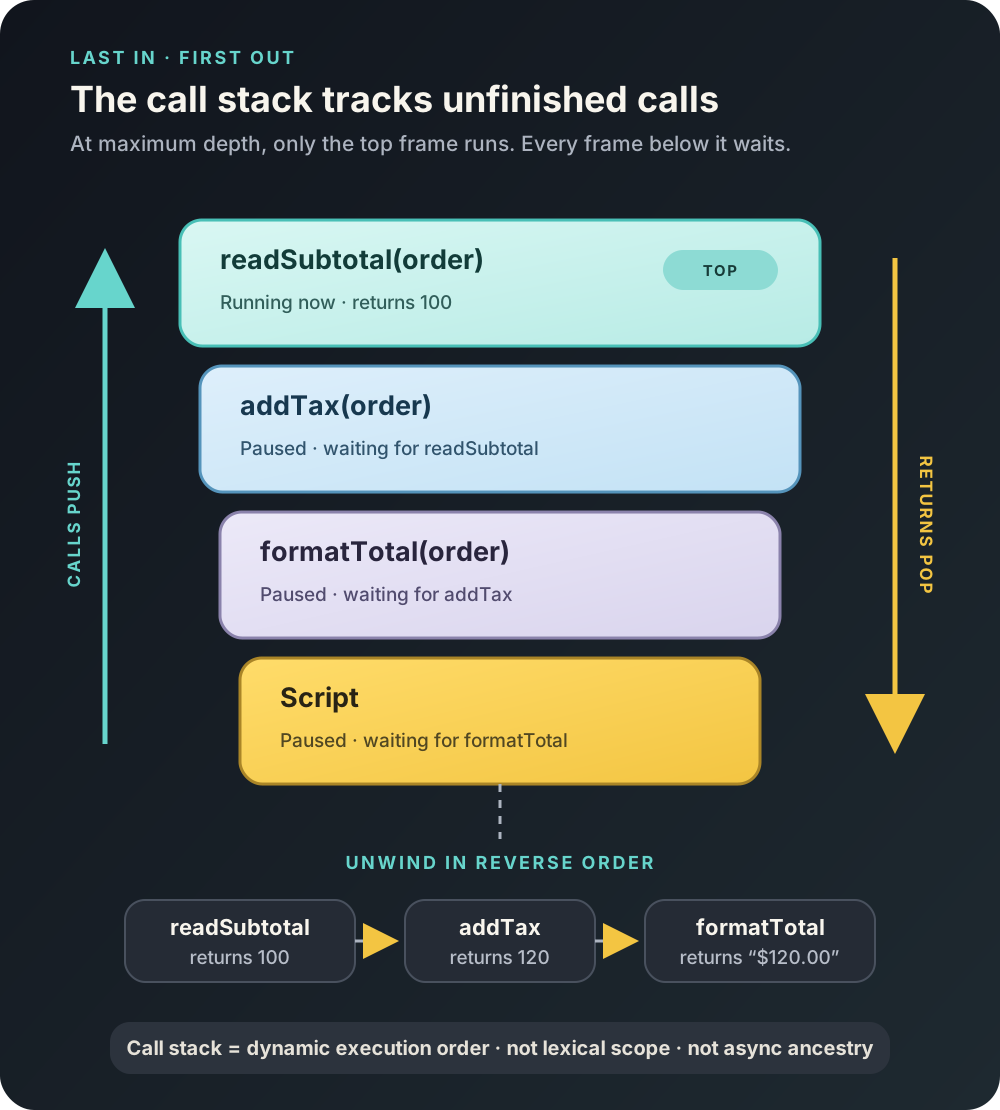
Only the top frame runs. Every frame below it represents an unfinished caller. Calls push frames; returns or uncaught throws remove them in last-in, first-out order until an earlier caller can resume.
The diagram shows dynamic calls, not lexical nesting, captured variables, or guaranteed physical engine frames.
Step-by-Step Runtime Walkthrough
The output is $120.00. The important states are:
- The script calls
formatTotal; the script waits. formatTotalcallsaddTax; both earlier calls remain unfinished.addTaxcallsreadSubtotal, producing maximum application depth.readSubtotalreturns100;addTaxresumes and produces120.addTaxreturns;formatTotalformats and returns the string.- The script resumes and logs the result.
Now consider error propagation:
function parsePrice(rawPrice) {
  const price = Number(rawPrice);
  if (!Number.isFinite(price)) throw new TypeError("Price must be numeric");
  return price;
}

function normalizeProduct(payload) {
  return { id: payload.id, price: parsePrice(payload.price) };
}

function handleProduct(payload) {
  try {
    return normalizeProduct(payload);
  } catch (error) {
    console.error("Invalid product", error);
    return null;
  }
}
parsePrice throws instead of returning normally. The throw exits parsePrice, propagates through normalizeProduct, and reaches the active catch in handleProduct. That handler converts the abrupt path into a normal return of null.
Why try/catch does not cross a later task
try {
  setTimeout(() => {
    throw new Error("Timer failed");
  }, 0);
} catch (error) {
  console.log("caught", error.message);
}
The catch does not run. The try surrounds the synchronous call to setTimeout. That call returns and its stack unwinds before the host invokes the timer callback in a later task. Handle the error inside the callback or represent the later result with a promise and handle its rejection.
Common Misconceptions
| Claim | Better explanation |
|---|---|
| “The stack stores every function that ran.” | It contains unfinished synchronous calls; traces and profiles record history separately. |
| “A stack trace is the live stack.” | It is a snapshot or reconstruction that can outlive the calls it describes. |
| “Displayed frames always match source calls.” | Optimization, inlining, bundling, and source maps affect what tools display. |
| “Async code stays on the stack while waiting.” | Later callbacks begin new synchronous call chains; async frames preserve causality only. |
| “Stack overflow has a standard depth.” | Limits vary by engine, platform, function shape, and available resources. |
| “Catching an error repairs the operation.” | A catch stops propagation, but state may already require rollback or validation. |
React Connection
React render work is still a synchronous JavaScript call chain. A deep stack is not automatically slow; total work matters. A shallow function containing a long loop can block input and paint more severely than many quick nested calls.
Use the browser Performance panel to measure main-thread work and the React Profiler to attribute render and commit work to components.
A JavaScript stack and a React component stack answer different questions:
- A JavaScript stack shows active function callers.
- A component stack shows ancestry in the rendered React tree.
This is why a parent's ordinary try/catch does not catch a descendant render failure:
function Parent() {
  try {
    return <Child />;
  } catch {
    return <p>Could not render child.</p>;
  }
}
Parent returns an element description. React invokes Child later in its own traversal, after the parent call has returned. Use an error boundary for descendant render failures. Event-handler and unrelated async errors still require handling in their own execution paths.
Performance and Memory Implications
- Depth is not duration. Use a CPU profile or performance trace to measure time.
- Recursion consumes bounded implementation resources. Prefer iteration or an explicit work stack when input can create extreme depth; do not rely on universal tail-call optimization.
- Capturing stacks has a cost. Error creation, high trace limits, and retained diagnostic metadata can consume CPU and memory.
- Popping a frame does not prove collection. Closures, suspended work, logs, or debugger state can retain referenced values.
Debugging Techniques
Read a conventional trace from the top application frame outward: the top shows where the failure surfaced; lower frames reconstruct callers.
In DevTools:
- Enable Pause on uncaught exceptions.
- Temporarily include caught exceptions when handling occurs too far from the cause.
- Inspect the Call Stack and invocation-specific locals at the pause.
- Distinguish authored, framework, and generated frames.
- Verify that production source maps match the exact deployed build.
- Treat async frames as scheduling ancestry rather than live callers.
console.trace() is useful for the current path. Avoid parsing error.stack as a stable cross-browser format.
Interview Questions
Level 1 — Fundamentals
Question: What is the JavaScript call stack?
Model answer:
The call stack is the practical model for unfinished synchronous calls. A callee runs above its suspended caller and returns control in last-in, first-out order. ECMAScript formally specifies an execution-context stack, while engines implement and optimize frames. A stack trace is therefore diagnostic output, not a standardized memory layout.
Level 2 — Applied understanding
Question: How does a thrown error move through the stack?
Model answer:
A throw produces an abrupt completion. If the current evaluation does not handle it, it propagates outward and active calls unwind until a matching catch handles it or the throw reaches the host as uncaught. A catch can return normally, rethrow, or throw a different error.
Level 3 — Senior reasoning
Question: Why can try/catch around setTimeout not catch an error from its callback?
Model answer:
The try surrounds only the synchronous scheduling call. setTimeout returns and that call chain finishes. The host invokes the callback in a later task with a new synchronous stack, so the old catch is no longer active. Async stack tooling may show the scheduling origin, but that does not restore the handler.
Level 4 — Deep follow-up
Question: Can a stack trace establish runtime cost or lexical scope?
Model answer:
No. A trace shows a dynamic call path, not the time consumed by each frame; performance requires profiling. It also shows callers rather than lexical outer environments, so it cannot establish identifier resolution. Optimization, source transformation, and async reconstruction further affect displayed frames.
Exercises
1. Trace maximum depth
function a(value) {
  return b(value) + 1;
}

function b(value) {
  return c(value * 2);
}

function c(value) {
  return value - 3;
}

console.log(a(5));
Solution
At maximum application depth the order from bottom to top is script → a → b → c. c(10) returns 7, b returns 7, and a adds 1, so the output is 8.
2. Predict finally
function getStatus() {
  try {
    throw new Error("failed");
  } catch {
    return "recovered";
  } finally {
    console.log("cleanup");
  }
}

console.log(getStatus());
Solution
The output is cleanup, then recovered. finally runs before the pending return completes. If finally returned or threw, that new abrupt completion would replace the earlier return.
3. Explain the React boundary
Why does try { return <Child /> } catch { ... } in a parent not catch an error thrown when React renders Child?
Solution
The parent returns an element description; it does not call Child inside that try. React invokes Child later during its traversal, after the parent call has returned. Use a React error boundary for descendant render errors and handle event or async errors in their own paths.
Chapter Summary
- Order: unfinished synchronous calls follow last-in, first-out control flow.
- Unwinding: returns and throws remove active calls; throws continue until handled.
- Diagnostics: stack traces represent execution paths but are not standardized live stacks.
- Async: later callbacks run on new synchronous stacks.
- Performance: stack depth does not measure duration, and recursion limits are implementation-specific.
- React: JavaScript stacks and component stacks represent different relationships.
Interview-ready explanation
The call stack is the practical last-in, first-out model for unfinished synchronous calls. A callee runs above a suspended caller, and returns remove calls in reverse order. Throws propagate as abrupt completions until an active catch handles them. ECMAScript specifies an execution-context stack, while engines implement and optimize physical frames, so stack traces are diagnostics rather than standardized memory layouts. Async callbacks run on later synchronous stacks; tools may link their scheduling ancestry, but the original callers and catch blocks are no longer active.
Further Reading
Finished this chapter?