`this` Binding
Weak explanations say that this refers to “the current object” or “the object that owns the function.” Neither rule predicts detached methods, callbacks, arrows, bound functions, constructors, or strict mode. Senior interviews expect you to read the call expression and identify the receiver without guessing from where the function was defined.
Chapter 7 — this Binding
Learning objectives
After completing this chapter, you should be able to:
- determine
thisfrom a function's invocation form; - explain why extracting a method changes its receiver;
- distinguish ordinary, arrow, bound, and constructor calls;
- explain strict-mode and non-strict-mode fallback behavior;
- use
call,apply, andbindprecisely; - diagnose lost-receiver bugs in callbacks, classes, DOM code, and React.
Quick Refresher
- For an ordinary function,
thisis usually determined when the function is called. object.method()callsmethodwithobjectas the receiver.- Copying
object.methodinto a variable does not permanently attach it toobject. - A plain strict-mode call receives
undefinedasthis. - Arrow functions do not create their own
this; they use the surrounding lexicalthis. callandapplyinvoke immediately with an explicit receiver;bindcreates a new function.newcreates a receiver and invokes a constructable function as a constructor.- Passing a method as a callback often loses its original receiver.
Why This Matters
Weak explanations say that this refers to “the current object” or “the object that owns the function.” Neither rule predicts detached methods, callbacks, arrows, bound functions, constructors, or strict mode. Senior interviews expect you to read the call expression and identify the receiver without guessing from where the function was defined.
The same skill prevents production failures such as an event handler losing a class instance, a private method throwing after extraction, or a callback silently writing to the wrong object.
Core Mental Model
For an ordinary function, start with the call site:
| Invocation | Resulting this |
|---|---|
account.read() | account |
read() in strict mode | undefined |
read.call(account) | account |
read.apply(account, args) | account |
read.bind(account)() | The bound account |
new Account() | A newly created receiver |
| Arrow function call | No new this; use the enclosing lexical value |
"use strict";

const account = {
  balance: 100,
  read() {
    return this.balance;
  },
};

console.log(account.read()); // 100

const detached = account.read;
console.log(detached()); // TypeError: this is undefined
The function did not change. The invocation changed from a property-reference call to a plain call, so the receiver was lost.
Visual Model
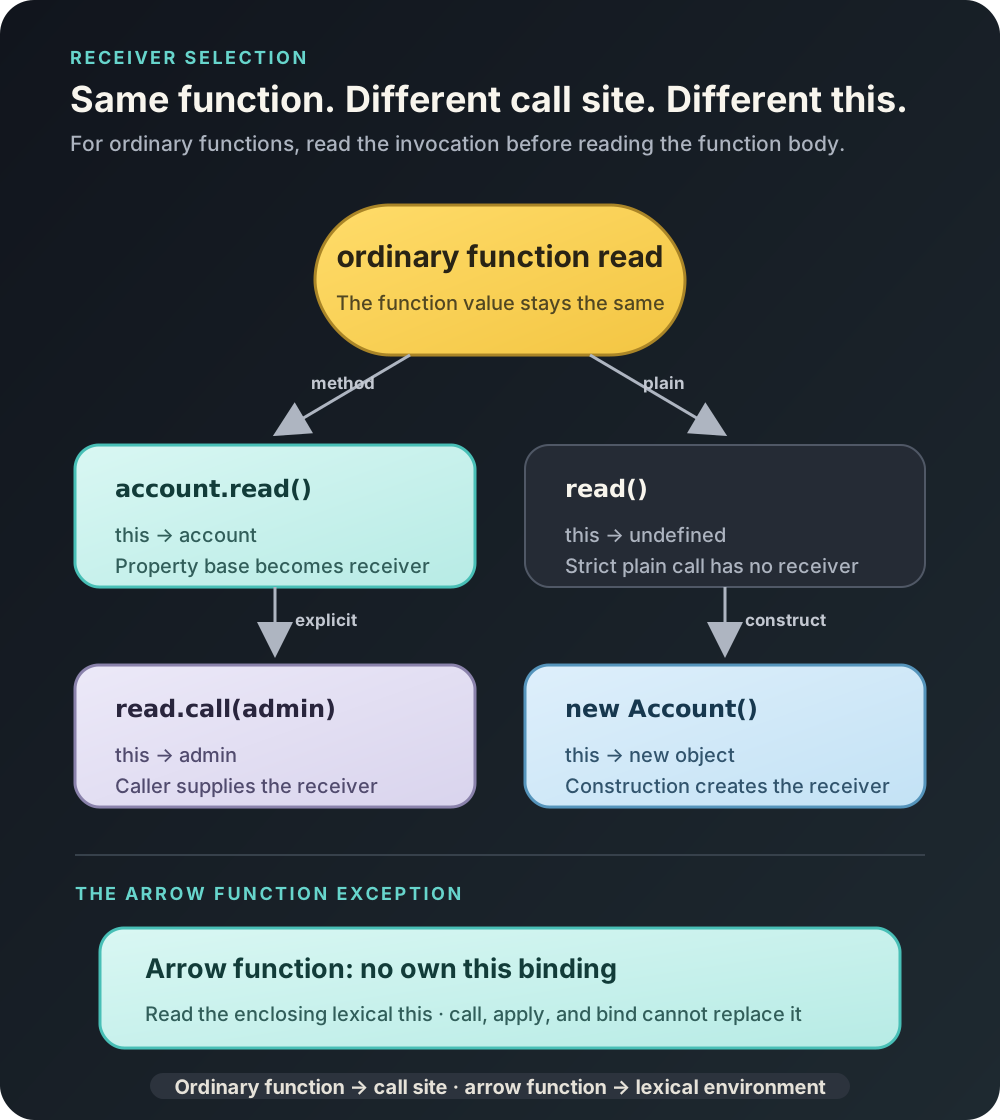
For an ordinary function, the invocation selects the receiver: a method call preserves the property base, a strict plain call has no receiver, call supplies one explicitly, and new creates one. Arrow functions follow a separate rule because they read this lexically instead of receiving it from the call site.
Formal Model
A method call preserves a reference base
Evaluating account.read produces an internal property Reference Record whose base is account. Calling that reference supplies the base object as this.
account.read();
Extraction first obtains the function value and discards the property reference:
const read = account.read;
read();
This is why “the function belongs to the object” is misleading. Functions are values; the call expression determines whether a receiver is supplied.
Parentheses alone do not normally detach a method:
account.read(); // this === account
But expressions that produce only the function value do:
(0, account.read)();
const { read } = account;
read();
Plain calls and strictness
For a plain call to an ordinary function:
- strict-mode code keeps
thisasundefined; - legacy non-strict code substitutes the global object for
undefinedornulland boxes primitive receivers.
Modules and class bodies are strict. Modern code should not depend on global-object substitution.
function strictReceiver() {
  "use strict";
  return this;
}

console.log(strictReceiver()); // undefined
Explicit receivers: call, apply, and bind
call and apply invoke a function immediately:
function describe(prefix, suffix) {
  return `${prefix}${this.name}${suffix}`;
}

const user = { name: "Mina" };

describe.call(user, "User: ", ".");
describe.apply(user, ["User: ", "."]);
bind creates a new bound function and can also prefill arguments:
const describeUser = describe.bind(user, "User: ");
console.log(describeUser(".")); // User: Mina.
Calling call or apply on a bound function cannot replace its bound receiver. If a bound function is used with new, construction creates the receiver instead; the stored bound this is ignored, while bound arguments still apply.
Arrow functions use lexical this
An arrow function has no own this binding. Reading this inside it continues through the surrounding lexical environment.
const timer = {
  seconds: 0,
  start() {
    setInterval(() => {
      this.seconds += 1;
    }, 1000);
  },
};
The arrow uses the this of start. Replacing it with an ordinary callback would give that callback a receiver according to how the host invokes it, not according to where it appears in the source.
Because arrows have no own this, call, apply, and bind cannot change the value they read. Arrow functions also cannot be used as constructors.
Constructor calls
For new Constructor(...args), the language broadly:
- creates a new object linked to
Constructor.prototype; - invokes the constructor with that object as
this; - returns the explicit result if it is an object, otherwise returns the created object.
function Account(balance) {
  this.balance = balance;
}

const account = new Account(100);
In a derived class constructor, this remains uninitialized until super() completes. Accessing it earlier throws.
Class methods and private fields
Class methods are strict but not automatically bound:
class Counter {
  #count = 0;

  increment() {
    this.#count += 1;
  }
}

const counter = new Counter();
const increment = counter.increment;
increment(); // TypeError
The detached call supplies undefined, and private-field access also requires a receiver carrying the correct private brand. Bind the method, wrap the call, or use an instance field arrow when its per-instance identity and allocation are intentional.
Step-by-Step Runtime Walkthrough
Predict the output:
"use strict";

const player = {
  name: "Ada",
  score: 10,
  add(points) {
    this.score += points;
    return `${this.name}: ${this.score}`;
  },
};

const detached = player.add;
const bound = player.add.bind(player, 5);

console.log(player.add(2));

try {
  detached(3);
} catch (error) {
  console.log(error.name);
}

console.log(bound());
console.log(player.score);
The output is:
Ada: 12
TypeError
Ada: 17
17
Trace the call sites:
player.add(2)preserves the property reference, sothisisplayer.detached(3)is a plain strict-mode call, sothisisundefined.bound()uses the receiver and first argument stored bybind.- Both successful calls mutate the same
player.scoreproperty.
Important Examples
Passing a method as a callback
class SearchTracker {
  constructor() {
    this.count = 0;
  }

  record() {
    this.count += 1;
  }
}

const tracker = new SearchTracker();

button.addEventListener("click", tracker.record); // receiver is not tracker
button.addEventListener("click", () => tracker.record()); // receiver is tracker
A callback consumer controls how it invokes the function. Passing a method value does not preserve the original object. A wrapper creates a new call site that explicitly uses tracker as the receiver.
For DOM listeners registered as ordinary functions, browsers set this to the listener's currentTarget. Prefer the explicit event.currentTarget; it is clearer and also works with arrows.
Borrowing a method
const first = {
  name: "first",
  identify() {
    return this.name;
  },
};

const second = { name: "second", identify: first.identify };

console.log(second.identify()); // second
The function was defined in first, but second is the receiver at this call site. Unlike lexical variables, ordinary-function this does not come from the function's creation environment.
Common Misconceptions
| Claim | Better explanation |
|---|---|
“this is the object that owns the function.” | Ordinary-function this is generally determined by invocation, not ownership. |
“this refers to the current function.” | It is a receiver value, not the function object. |
“Arrow functions bind this permanently.” | Arrows have no own this; they read the enclosing lexical value. |
| “Methods are automatically bound.” | Extracting a method usually removes the property-reference receiver. |
“bind changes the original function.” | It returns a new bound function with different identity. |
“call can change an arrow's this.” | Explicit-receiver operations cannot create a binding an arrow does not have. |
| “Callbacks keep the receiver from where they came.” | The callback consumer determines the later invocation form. |
React Connection
Function components do not use this; props and state are lexical bindings. This avoids an entire category of receiver bugs but does not remove closures or function identity concerns.
Legacy class components do use instance methods:
class SaveButton extends React.Component {
  handleClick() {
    this.props.onSave();
  }

  render() {
    return <button onClick={() => this.handleClick()}>Save</button>;
  }
}
The wrapper calls this.handleClick() as a method. Common alternatives are binding once in the constructor or using an instance field arrow:
handleClick = () => {
  this.props.onSave();
};
These approaches produce different function identities and allocation patterns. Binding or creating wrappers during every render can also defeat shallow equality or memoization when identity matters. Correctness comes first; optimize identity only where measurement or component contracts justify it.
When a function component passes service.save directly, the ordinary JavaScript detached-method rule still applies. React does not restore the service receiver.
Performance and Debugging
Receiver selection itself is rarely a useful optimization target. More practical concerns are accidental function allocation and unstable callback identity from repeated bind or wrapper creation.
When this is wrong:
- Find the exact call expression, not only the function definition.
- Classify it as method, plain, explicit, bound, constructor, or arrow behavior.
- Check whether destructuring or callback passing discarded a property reference.
- Confirm whether strict mode turns the missing receiver into
undefined. - Inspect transpiled code only after understanding the source-level call.
At a breakpoint, inspect this in the current frame and compare it with the expected object. For private-field errors, verify both receiver presence and private brand. Avoid “fixing” receiver bugs with a global arrow conversion: arrows are appropriate only when lexical this is the intended contract.
Interview Questions
Level 1 — Fundamentals
Question: How is this determined in JavaScript?
Model answer: For an ordinary function, start from the invocation. A property-reference call supplies its base object, a strict plain call supplies undefined, call and apply supply an explicit receiver, bind stores one for later calls, and new creates one. Arrow functions are different because they use lexical this from the surrounding environment.
Level 2 — Applied understanding
Question: Why does an extracted method often fail?
Model answer: object.method() preserves a property Reference Record whose base becomes this. Assigning object.method to a variable retrieves only the function value. Calling that variable is a plain call, so the original object is no longer supplied as the receiver.
Level 3 — Senior reasoning
Question: When would you choose a wrapper, bind, or an arrow instance field?
Model answer: A wrapper makes the receiver and arguments explicit at one call site. bind creates a reusable function with a fixed receiver and optional partial arguments. An arrow instance field provides lexical instance access but creates a function per instance and changes prototype-method semantics. I choose based on lifetime, identity requirements, and API expectations rather than style alone.
Level 4 — Deep follow-up
Question: What happens when a bound constructor is called with new?
Model answer: If the target is constructable, new creates the receiver and the bound this value is ignored. Bound arguments are still prepended. Construction behavior comes from the target function, and the resulting object follows the target's construction semantics.
Exercises
1. Predict the receiver
"use strict";

const box = {
  value: 3,
  read() {
    return this?.value;
  },
};

const read = box.read;

console.log(box.read());
console.log(read());
console.log(read.call({ value: 7 }));
Solution
The output is 3, undefined, and 7. The optional chain inside read prevents an error for the strict plain call; it does not restore the lost receiver.
2. Explain the arrow
const panel = {
  title: "Settings",
  createReader() {
    return () => this.title;
  },
};

const read = panel.createReader();
console.log(read.call({ title: "Profile" }));
Solution
The output is Settings. createReader() runs with panel as this, and the arrow reads that surrounding lexical value. call cannot provide the arrow with a different this binding.
3. Repair the callback
class Controller {
  save() {
    return this.repository.commit();
  }
}

queue.add(controller.save);
Give two valid repairs and explain their identity or lifetime trade-off.
Solution
Pass controller.save.bind(controller) and retain that bound function if removal later requires the same identity, or pass () => controller.save() and retain the wrapper for the same reason. Binding once during initialization avoids creating a new callback at every registration or render.
4. Explain construction
What receiver does new BoundAccount(100) use if BoundAccount was created with Account.bind(existingAccount)?
Solution
Construction creates a new receiver; it does not use existingAccount. Any arguments stored by bind are prepended to the constructor arguments.
Chapter Summary
- Ordinary-function
thisis determined primarily by the invocation form. - Method syntax preserves a property-reference base; method extraction discards it.
- Strict plain calls receive
undefined; modern code should not rely on global fallback. - Arrows use lexical
thisand cannot be rebound or constructed. callandapplyinvoke explicitly;bindcreates a new function.newcreates a receiver and applies constructor return rules.- Callback APIs frequently expose lost-receiver bugs.
- React function components avoid
this, but passed service methods still follow JavaScript rules.
Interview-ready explanation
For an ordinary JavaScript function, I determine this from the call expression. object.method() supplies object because the property reference retains its base. Extracting the method leaves only a function value, so a strict plain call receives undefined. call and apply provide an explicit receiver, bind creates a function with a stored receiver, and new creates a receiver for construction. Arrow functions are the exception: they have no own this and read it lexically from the surrounding environment. This model explains detached callbacks, class-method errors, and why passing service.save through React does not preserve service.
Further Reading
Finished this chapter?